

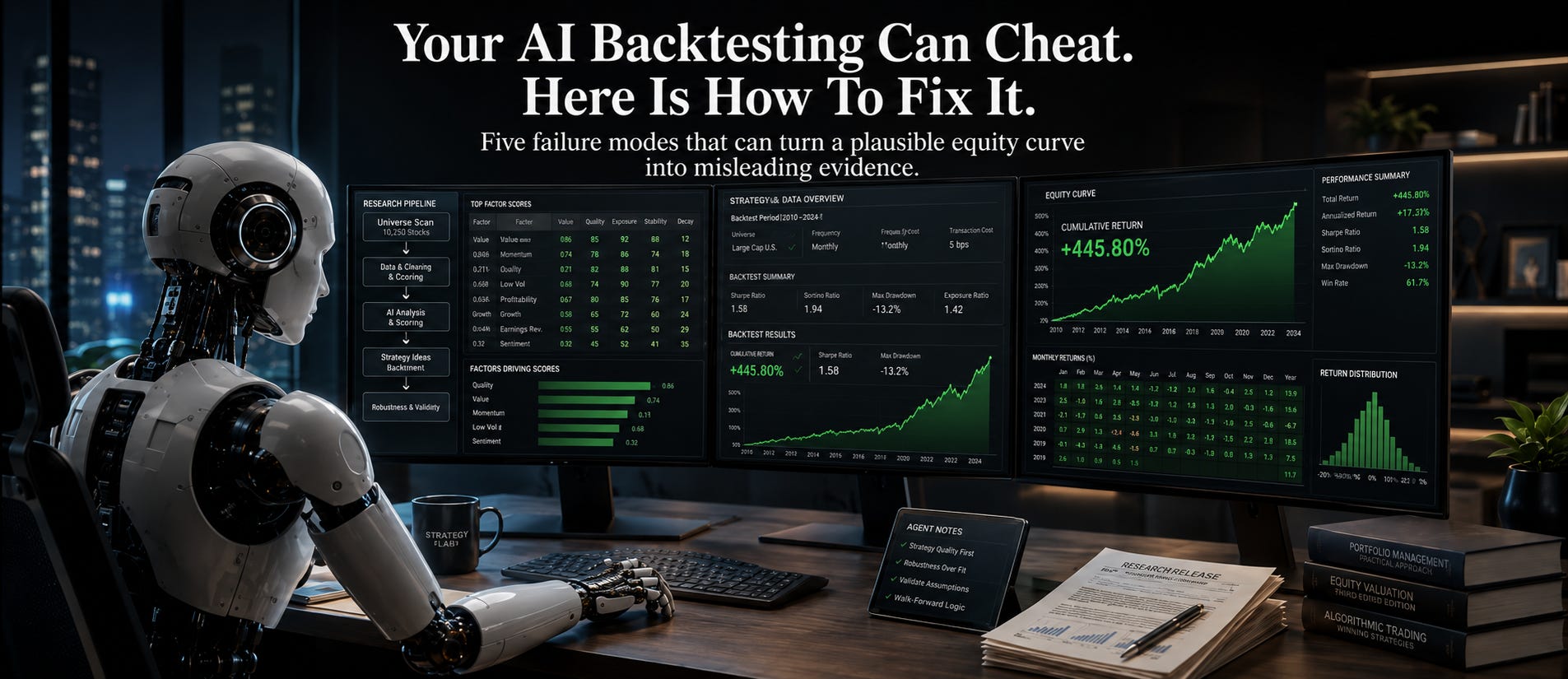
Ask an AI to backtest a trading idea and it will almost always find you a winner. That’s the problem.
We saw it in our own research. One of our internal strategies buys stocks after an unusually upbeat earnings call. It came back from its first test looking like the best thing we’d built all year: a 20.6% annualized return, a Sharpe of 0.92, a clean edge over its benchmark.
Then we tested it properly. One line changed in a config file, and the edge disappeared.
That gap between what a backtest says on the first run and what’s true is documented, not a one-off. A review of 164 papers on LLM trading strategies found that most results looking strong on training data failed to beat simple buy-and-hold once tested honestly. No known failure mode was discussed in more than 28% of those papers.
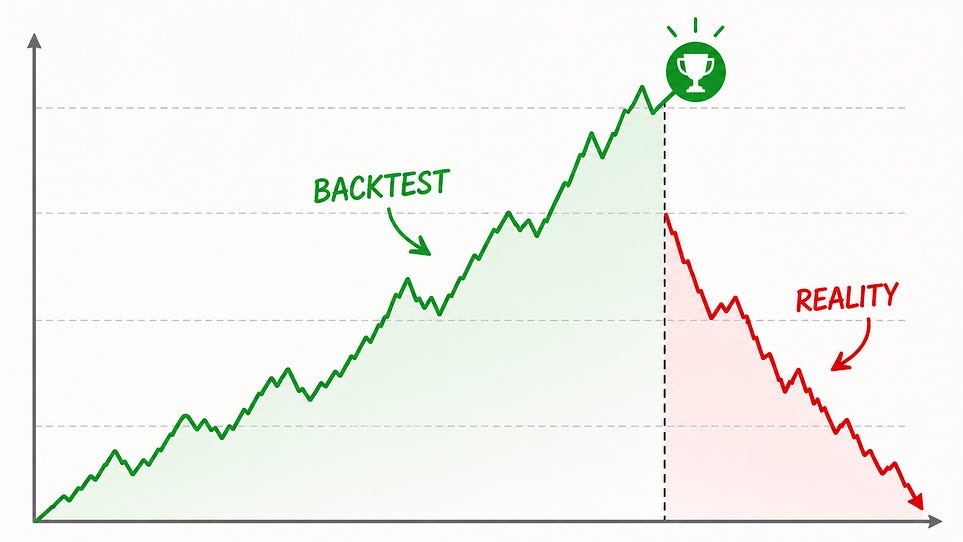
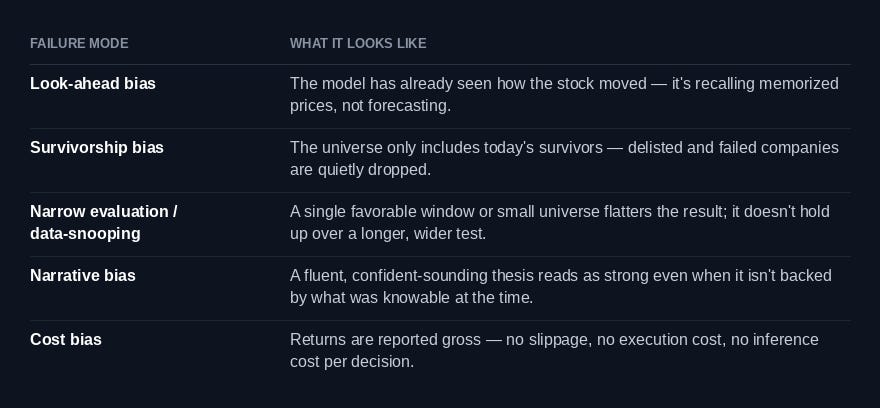
Five ways an AI backtest fools you
Look-ahead bias: it has already seen the answer
This is the one failure mode specific to LLMs. It doesn’t exist in traditional quant testing.
A model trained on internet-scale data has, by construction, absorbed how stocks like Nvidia or Netflix moved during its training years. Researchers have shown language models can recall historical S&P 500 prices close to verbatim. Point that model at a “backtest” covering 2015 to 2020 and you’re testing memory, not foresight.
The only clean fix is to restrict the test window to dates after the model’s training cutoff. That’s why the strongest recent papers confine their evaluation to a short post-cutoff period, even though it leaves them with a smaller, less comfortable sample.
Survivorship bias: the survivors are the only ones left standing
Most evaluation universes are built from today’s index membership. That quietly drops every company that got delisted, acquired in distress, or went to zero.
Fund-return studies put the bias at roughly a percentage point a year. It hurts stock-picking more than it hurts diversified funds, because a picking strategy is more likely to have wandered into the names that didn’t make it.
Narrow evaluation and data-snooping: a narrow window flatters almost anything
FINSABER, a widely cited replication effort, took LLM trading strategies that looked strong in their original papers and re-ran them across two decades and more than 100 stocks. The original papers used a much narrower slice.
The advantage mostly evaporated. Worse, the surviving pattern was backwards: the strategies were too cautious in bull markets and too aggressive in bear markets, the opposite of what you’d want.
Narrative bias: a confident thesis isn’t a correct one
This one is easiest to miss because it doesn’t show up in the numbers. It shows up in how convincing the write-up feels.
An LLM can produce a fluent, well-structured investment rationale that nothing knowable at the time supports. Alignment training makes it worse. Models are rewarded for giving a confident answer rather than admitting “insufficient signal,” which nudges an agent toward always having a take, even when the honest one is “pass.”
Cost bias: the backtest assumes trading is free
Papers frequently report gross returns: zero slippage, zero execution cost. For an LLM-driven agent, that also means zero inference cost per decision.
Net those out and a lot of “winning” systems stop making sense as something you’d run.
The Practices That Make AI Backtesting More Reliable
Three papers hold up here. StockBench tests agents only on data available at decision time. FINSABER is a stricter replication of published LLM strategies. FinCAD audits whether an agent’s reasoning is backed by what was knowable.
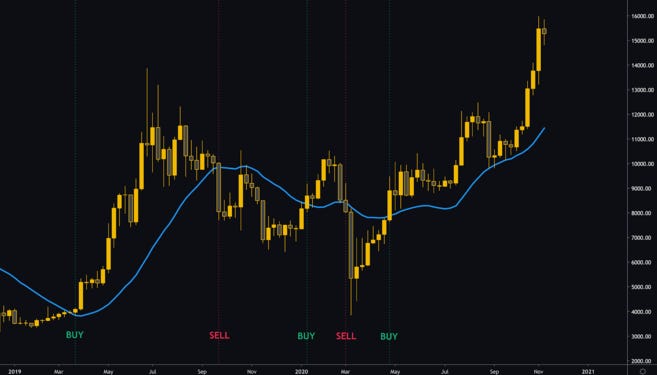
Test only on dates the model couldn’t have memorized. StockBench’s design principle is that a trading agent sees only data available up to the moment of each decision, with historical slices built to fall strictly after the model’s training cutoff.
It’s the cleanest fix for look-ahead bias. The honest tradeoff is a shorter window, too short on its own to support an airtight conclusion. That’s a cost worth paying.
Evaluate on rolling windows, not one lucky slice. FINSABER tests strategies on a 2-year rolling window with a 1-year step, allowing up to 3 years of prior data for training at each step. A strategy has to keep working as the window moves, not just in the one stretch someone happened to report.
Build the universe from historical constituents, not today’s survivors. FINSABER’s fix for survivorship bias is to use index membership as it stood at each historical date, delisted names and all.
Benchmark against buy-and-hold, always. Most LLM-based agents don’t beat buy-and-hold once tested properly. A lot of impressive-looking backtests never ran the comparison at all.
Timestamp everything and net out real costs. Every piece of data an agent retrieves needs a “when was this knowable” field, with ingestion lag and embargo periods enforced. Not the publication timestamp, and not a retroactively cleaned filing. Then report every result net of trading costs, slippage, and inference cost per decision.
One more, if you run multiple agent “roles”: log full reasoning traces, not just the final call. That lets you audit narrative bias after the fact. Did the thesis cite what was knowable at the time, or is it a plausible story built backward from the outcome? And if those roles share one underlying model, be honest that they aren’t independent checks.
What we actually caught
We test our own AI-assisted strategies this way, and it recently paid off.
One internal candidate was an earnings-call sentiment strategy we’d nicknamed ToneFresh. It buys S&P 500 names that just reported an unusually upbeat earnings call, on the theory that markets price the numbers instantly but take weeks to digest the narrative.
On the first pass it was the best-performing idea in the batch: a 20.6% annualized return, a Sharpe of 0.92, and a clear edge over an equal-weight benchmark built from the same eligible stocks rather than a raw index.
By most standards, that’s a strategy you’d write up and ship. It’s also, on closer inspection, dead.
The cause was narrow evaluation, problem #3 above. We’d tested it on a single quarterly window, and that window flattered the strategy for reasons that had nothing to do with sentiment. The model was picking up which companies happened to report earnings late in the quarter, not which ones sounded upbeat. One narrow, favorable slice produced a convincing false positive.
So we retested across rolling windows. Same strategy, same data. The edge over the equal-weight benchmark went from +0.229 in Sharpe terms to -0.020.
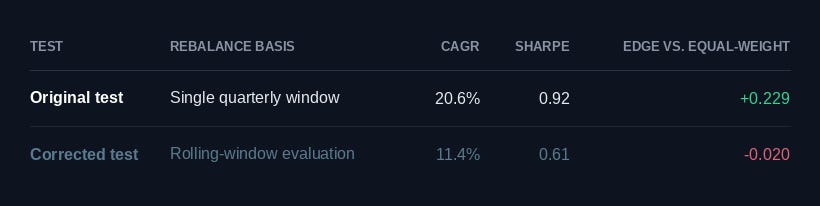
Tested properly, ToneFresh trails a portfolio of darts thrown at the same eligible names. The first test just wasn’t rigorous enough to show it. Without the rerun, there would have been a real temptation to quietly keep the flattering number and call it a strategy.
The takeaway
None of the five failure modes are exotic. They’re versions of the same mistake: judging a strategy on a test that was, in some quiet way, rigged in its favor.
The rigging comes from memorized data, a survivor-only universe, a window too narrow to be representative, a fluent story standing in for evidence, or costs the backtest never charged. An LLM makes all five easier to fall into, because it can generate a plausible rationale for almost any result, including a wrong one.
AI doesn’t solve the underlying problem of backtesting. It makes it faster to produce convincing false positives.
So ask the harder question before the fact: what result would prove this idea false, and are we running the test that could produce it? ToneFresh looked like our best strategy right up until we asked it.
References:
FINSABER (KDD 2026) — https://arxiv.org/abs/2505.07078
StockBench — https://arxiv.org/abs/2510.02209
FinCAD (”Summoning the Oracle to Slay It”) — https://arxiv.org/abs/2605.24564
BacktestBench — https://arxiv.org/abs/2605.17937
“Beyond Agent Architecture” — https://arxiv.org/abs/2606.08285
PredictionMarketBench — https://arxiv.org/abs/2602.00133
Great points! There are also 2 other aspects of backtesting with AI agents that people are not aware of enough:
1) Agent stochasticity - try running the same backtest under the exact set up the results could be very different. This stems from the inherent non-deterministic behaviour of LLMs. It also grows with more agentic capability (more turns and tool calls). In a study I did an Openclaw-like ReAct agent could vary 4x compared to single-turn agent. Your IR/Sharpe is just one draw from a distribution if you don't control for this by doing multiple runs and ensembling
2) Agentic components (model, harness, tools...) interact non-monotonically. Slapping the best model on the best harness with all the tools does not mean a better agent. In fact, for most cases a simpler agent could perform better due to lower hallucination/error rate that are usually higher in a "smart" model and "better" harness. For any serious deployment, you need to take this into account and run backtests on simpler variants to ensure that you are not burning unnecessary tokens for lower performance.